Starting With The Name Of Almighty Allah
Understanding the Qurbani meaning helps answer an important question for Muslims every year: what is Qurbani, and why does it matter so much in Islam? Qurbani is more than a ritual slaughter performed during Eid al-Adha. It is an act of worship, obedience, remembrance, and gratitude to Allah. It connects the believer to the legacy of Prophet Ibrahim A.S, the devotion of Prophet Ismail A.S, and the spirit of submission that lies at the heart of Islamic faith.
For readers who want the broader festival context, Eid al-Adha: Meaning, Significance, Rituals, and Complete Guide for Muslims helps connect Qurbani to the wider season of worship. For families building a stronger foundation in deen, Online Quran classes can also be a helpful way to study these themes with more confidence.
In everyday Muslim usage, especially in South Asia, the word “Qurbani” is commonly used for the sacrificial offering made during the days of Eid al-Adha. In classical Islamic terminology, this sacrifice is usually called Udhiyah. Both words point to the same basic idea: an animal sacrifice offered as a religious act during the prescribed days of Dhul Hijjah.
For learners seeking clear Islamic guidance, the topic of Qurbani in Islam is not just about rules. It is about understanding why Muslims sacrifice, what the sacrifice represents, who is required to offer it, and how the act should be performed correctly.
Qurbani Meaning in Islam
The term Qurbani is commonly understood as a sacrifice offered for the sake of Allah. Linguistically, it comes from the idea of drawing near, because the sacrifice is a means of seeking closeness to Allah through obedience. The Arabic term Udhiyah refers specifically to the animal slaughter performed after Eid prayer during the days of sacrifice.
So when people ask, “What is Qurbani?”, the simplest answer is this:
Qurbani is the sacrificial offering of a permitted animal, performed as an act of worship during the Eid al-Adha period, following the Sunnah of Prophet Ibrahim A.S and the guidance of Prophet Muhammad S.A.W.
This is not the same as ordinary meat consumption or charity. It is a regulated act of devotion with spiritual meaning, time limits, and legal conditions. That is why the phrase Qurbani rules and conditions matters so much. A sacrifice only counts as Qurbani when it is done according to Islamic guidance.
For students who want to understand these terms more deeply, Online Quran Learning can make the Qur’anic meaning and language behind worship easier to grasp.
“Indeed, my prayer, my sacrifice, my living and my dying are for Allah, Lord of the worlds.” (Quran 6:162)
This verse captures the essence of worship in Islam: every act, including sacrifice, should be directed only to Allah.
What Is Qurbani in Islam?
To understand what is Qurbani in Islam, it helps to see it in three layers:
- As worship — Qurbani is an act done for Allah alone.
- As remembrance — it recalls the sacrifice and submission of Prophet Ibrahim A.S.
- As social mercy — the meat is shared with family, neighbors, and those in need.
Qurbani is not meant to impress people or display wealth. It is a spiritual act built on sincerity. The outward sacrifice of an animal symbolizes the inward sacrifice of ego, pride, and selfish desire.
Historically, Muslim scholars have treated Qurbani as one of the most visible rites of Eid al-Adha. In traditional Islamic law, it is a major ritual connected to the rites of Dhul Hijjah. Some academic readings also describe it as a communal act that preserves memory, identity, and generosity across generations. Those perspectives do not replace the religious meaning; rather, they help explain why Qurbani remains deeply meaningful in Muslim life.
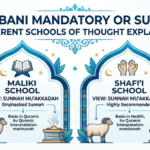
For a deeper breakdown of those juristic views, Is Qurbani Mandatory or Sunnah? Different Schools of Thought Explained offers a useful way to compare the major opinions side by side.
The Quranic Foundation of Qurbani
Qurbani is rooted in the Quranic command to sacrifice for Allah and in the story of prophetic obedience. Several verses provide the foundation.
“And for every nation We have appointed a rite of sacrifice so that they may mention the name of Allah over what He has provided for them of sacrificial animals. Your god is one God, so to Him submit.” (Quran 22:34)
This verse shows that sacrifice is not a random cultural practice. It is a divinely appointed rite tied to remembrance of Allah and submission to Him.
“Neither their meat nor their blood reaches Allah, but it is your piety that reaches Him.” (Quran 22:37)
This verse is essential for understanding the true spirit of Qurbani. The value of the sacrifice is not in the physical animal alone. What matters most is taqwa, sincerity, and obedience.
“So pray to your Lord and sacrifice.” (Quran 108:2)
This short but powerful verse connects prayer and sacrifice, showing that worship in Islam is both spiritual and practical.
Taken together, these verses make one thing clear: Qurbani is an act of devotion, not merely a ritual with food distribution attached to it.
The Prophetic Foundation: Authentic Hadith on Qurbani
The Sunnah of the Prophet S.A.W explains how Qurbani should be understood and practiced.
“The son of Adam does not do any deed on the Day of Sacrifice that is more beloved to Allah than shedding blood. Indeed, it will come on the Day of Resurrection with its horns, hair, and hooves, and its blood is accepted by Allah before it falls to the ground.” (Sahih Muslim 1966)
This hadith highlights the spiritual value of the sacrifice when it is done sincerely for Allah.
Another important hadith shows that the sacrifice must be done at the correct time:
“Whoever has slaughtered before the prayer, let him slaughter again in its place.” (Sahih Muslim 1977)
This clearly shows that a sacrifice made before the Eid prayer does not count as Qurbani.
A second timing-related hadith is also important:
“When the ten days begin and one of you wants to offer a sacrifice, let him not take anything from his hair or nails until he has sacrificed.” (Sahih Muslim 1977)
This narration is often discussed by scholars as part of the etiquette and legal rulings connected to Qurbani.
In the same way that students often seek guidance through Online Quran Academy study circles, the fiqh of sacrifice becomes much clearer when it is learned step by step and with reliable scholarly guidance.
Who Should Give Qurbani?
One of the most searched questions is who should give Qurbani. The answer depends partly on the school of Islamic law, so it should be explained carefully.
In the Hanafi school, Qurbani is wajib for every sane, adult Muslim who is financially able. Financial ability is commonly understood through the possession of wealth at or above the nisab threshold, after basic needs and debts are considered.
In the Shafi‘i, Maliki, and Hanbali schools, Qurbani is generally considered a highly emphasized Sunnah for those who can afford it.
This difference is important, especially for Muslims in the USA and UK who follow different scholarly traditions. Even with this juristic difference, all major schools agree that Qurbani is a highly virtuous and central act of worship during Eid al-Adha.
In Practical Terms, Qurbani Applies To:
- Adult Muslims
- Those who are mentally sound
- Those who are financially capable
- Those who meet the legal requirements according to their school of fiqh
It Does Not Apply To:
- Non-Muslims
- Children who have not reached maturity
- People who are not financially able
- Those who have no valid ownership of a sacrificial animal or share
For a more detailed breakdown of financial criteria and scholarly interpretations, Who Is Obligated to Perform Qurbani? Rules, Eligibility & Islamic Guidelines provides a deeper explanation of eligibility across different situations.
Qurbani Rules and Conditions
Understanding Qurbani rules is essential so the sacrifice is valid and accepted. Below is a clear summary.
| Rule or Condition | Explanation |
| Intention | The sacrifice must be done for Allah, not for show or custom alone. |
| Timing | It must be done after the Eid prayer on 10 Dhul Hijjah and within the valid days of sacrifice. |
| Days of sacrifice | The main days are 10, 11, 12, and 13 Dhul Hijjah, depending on scholarly position. |
| Animal type | Camel, cow, buffalo, sheep, or goat are generally accepted, subject to Islamic rules. |
| Age of animal | The animal must meet the minimum age requirement set by Islamic law. |
| Health condition | The animal must be free from major defects that make it unsuitable for sacrifice. |
| Ownership | The animal or share must be lawfully owned by the person offering Qurbani. |
| Distribution | Meat should be divided fairly, with a portion given to those in need. |
For a fuller fiqh-based breakdown, Rules of Qurbani: Animal Types, Conditions, and Distribution (Shurut al-Udhiyah) explains the legal details in a more structured way. That kind of study is especially useful for Muslims who want to avoid common mistakes and perform the worship correctly.
Timing Matters Most
A sacrifice offered before the Eid prayer does not count as Qurbani. This is one of the most important legal points. The act must take place during the prescribed period, after the prayer has been performed in the relevant locality.
Animal Conditions
The animal used for Islamic animal sacrifice must meet the following general standards:
- It must be from the permitted species.
- It must reach the minimum age required in Islamic law.
- It must not have serious defects such as extreme illness, severe lameness, or obvious weakness that invalidates the sacrifice.
- It must be owned legitimately by the one offering it.
Shares in Larger Animals
For cows, buffaloes, and camels, multiple people may share the sacrifice according to Islamic rules. Traditionally, a cow or buffalo can be shared by up to seven people, provided that each share is intended as Qurbani and the arrangement follows the correct legal conditions.
Common Invalidators
A sacrifice may not count properly if:
- It is done before the correct time
- The wrong animal is used
- The animal has a disqualifying defect
- The person does not have valid ownership or permission
- The intention is not for Allah
For learners seeking structured guidance on Islamic rulings and worship, Online Quran Courses can provide step-by-step clarity on topics like Qurbani and other essential acts of worship.
The Spiritual Significance of Qurbani
The importance of Qurbani in Islam goes beyond meat distribution. It trains the believer in sincerity, obedience, and generosity.
It Teaches Submission to Allah
The story behind Qurbani is deeply tied to Prophet Ibrahim A.S. His willingness to obey Allah, even in the hardest command, remains one of the greatest examples of submission in Islamic history. Qurbani reminds Muslims that obedience to Allah should come before personal comfort and attachment.
For readers who want to revisit that sacred narrative in more depth, Prophet Ibrahim (AS) and Ismail (AS): The Story Behind Eid al-Adha provides an excellent companion discussion.
It Purifies the Heart
The sacrifice is not only about the animal. It is a chance to examine the heart. Are we willing to give up pride, greed, and selfishness for Allah’s sake? The outward act becomes a mirror for the inward state.
It Strengthens Community
Qurbani also has a social role. The meat is shared with family, neighbors, and the needy. That makes it one of the most practical acts of compassion in Islam. It turns worship into generosity and private devotion into public benefit.
A helpful follow-up on this topic is What to Do with Qurbani Meat: Distribution Rules in Islam, because the way meat is divided also reflects Islamic ethics and social responsibility.
It Revives the Sunnah
Every year, Qurbani reconnects the Muslim community to the Prophetic tradition. It is a living reminder that Islam is not only belief in the heart but also action in daily life.
Qurbani and Eid al-Adha
Qurbani is closely tied to Eid al-Adha, which is why many people call it the Eid al Adha sacrifice. The Eid prayer comes first, and then the sacrifice follows. The sequence is important because it reflects the correct order of worship.
Eid al-Adha itself commemorates faith, sacrifice, and obedience. The festival is not simply a celebration of meat or a holiday meal. It is a spiritual season that brings together prayer, remembrance, sacrifice, and generosity.
A Simple Step-By-Step Guide to Performing Qurbani
For those new to the practice, here is a simple outline.
- Make the intention for Qurbani sincerely for Allah.
- Choose a valid animal that meets Islamic requirements.
- Ensure the sacrifice is done after Eid prayer and within the valid days.
- Say the name of Allah at the time of slaughter.
- Confirm the animal is slaughtered in a lawful and humane manner.
- Distribute the meat according to local and family arrangements while remembering the poor.
This simple structure helps keep the worship focused and valid.
Common Mistakes to Avoid
Even sincere Muslims sometimes make mistakes with Qurbani. The most common ones include:
- Thinking Qurbani is just a cultural tradition
- Slaughtering too early
- Choosing an animal that does not meet the conditions
- Ignoring the importance of intention
- Treating the act as a social display
- Forgetting that piety matters more than appearance
The Quran makes the core principle unmistakable: it is taqwa that reaches Allah, not blood or flesh.
Why Qurbani Still Matters Today
In modern life, some people may wonder whether Qurbani still has the same relevance. The answer is yes. In fact, its relevance is stronger than ever.
Qurbani teaches Muslims living in the USA, UK, and elsewhere that Islam is not detached from daily life. It brings theology, family, charity, and community together in one worshipful act. It also reminds Muslims living in non-Muslim majority environments that their faith has a clear rhythm, history, and sacred calendar.
For children and new Muslims, learning what is Qurbani can open a wider understanding of Islamic identity. For practicing adults, revisiting its meaning often renews sincerity and gratitude.
Conclusion
Qurbani is one of the most meaningful acts of worship in Islam. Its Qurbani meaning is not limited to sacrifice in the physical sense; it represents nearness to Allah, obedience to divine command, remembrance of Prophet Ibrahim A.S, and compassion for others. The Quran teaches that what matters most is piety, while the authentic Sunnah explains the correct way to perform the sacrifice. Understanding Qurbani rules, knowing who should give Qurbani, and appreciating the spiritual wisdom behind the act all help Muslims approach Eid al-Adha with greater awareness and sincerity.
For learners who want structured Islamic education and dependable Quran study, Online Quran Teachers remain a trusted support for students who want clear guidance, affordable learning, and a stronger connection to the Quran and Sunnah.
Educational Disclaimer:
This article is for educational purposes only and does not constitute a fatwa. Please consult qualified scholars for personal rulings.
References
Quranic References:
- Quran 6:162
- Quran 22:34
- Quran 22:37
- Quran 108:2
Hadith References:
- Sahih Muslim 1966
- Sahih Muslim 1977
About the Author:
With over 18 years of experience in Islamic education and teaching, I have dedicated my work to helping students and readers develop a deeper understanding of Islam through authentic knowledge and practical guidance. My studies include Quran, Hadith, Aqeedah, Seerah, and Islamic history under qualified scholars, with a strong focus on presenting classical Islamic teachings in a clear, balanced, and accessible way for modern audiences. Through years of teaching, curriculum development, and educational mentoring, I aim to make Islamic learning engaging, reliable, and spiritually enriching for students of all ages.
Syed Fawwad Ahmed