Starting With The Name Of Almighty Allah
Eid al-Adha is one of the two major Islamic festivals celebrated by Muslims around the world. If you have ever wondered, what is Eid al-Adha, the simplest answer is this: it is the “Festival of Sacrifice,” and it honors the devotion, obedience, and trust of Prophet Ibrahim (AS) and his family. It is a time of prayer, remembrance of Allah, sharing food, giving charity, and performing sacrifice for those who are able.
For beginners, the topic can sound deep and historical, but the idea is actually very clear. Eid al-Adha teaches Muslims that true faith is not only about belief in the heart; it is also about obedience, sincerity, patience, and compassion in action. In this article, we will walk through the simple meaning of Eid al-Adha, the story behind it, and why it remains so important in Islam today. For readers who want to build a stronger Qur’anic foundation alongside this topic, Online Quran classes can be a practical starting point.
For a broader overview of the festival itself, Eid al-Adha: Meaning, Significance, Rituals, and Complete Guide for Muslims offers a useful companion perspective.
What Is Eid al-Adha In Islam?
Eid al-Adha in Islam is the annual Islamic festival that comes during the month of Dhul-Hijjah, after the completion of Hajj. It is celebrated on the 10th day of Dhul-Hijjah and continues for several days afterward. The occasion is directly connected to the remembrance of Prophet Ibrahim (AS), his son Ismail (AS), and their complete submission to Allah’s command.
The Eid al-Adha clear explanation is this: Muslims celebrate Allah’s mercy and the legacy of faith shown by Prophet Ibrahim (AS). The festival is called the festival of sacrifice in Islam because it includes the act of animal sacrifice for those who can afford it, as a symbol of devotion to Allah and service to others.
This celebration is not just a cultural custom. It is deeply rooted in the Qur’an and Sunnah, which makes it a central part of Islamic worship and identity. For students who want a structured way to understand these meanings, Online Quran Learning can help connect the story, the verses, and the practical worship together.
The Story Behind Eid al-Adha
To understand the story of Prophet Ibrahim Eid al-Adha, we need to go back to the Qur’anic narrative. Allah showed Prophet Ibrahim (AS) a dream in which he was instructed to sacrifice his beloved son. Instead of resisting, Ibrahim (AS) submitted to Allah’s command with complete trust. His son Ismail (AS) also responded with faith and patience. Allah then replaced Ismail (AS) with a great sacrifice, showing that the purpose was never human loss, but obedience, faith, and surrender to Allah.
“Then when the boy reached the age to work with him, Abraham said, ‘O my dear son! I have seen in a dream that I ˹must˺ sacrifice you. So tell me what you think.’ He replied, ‘O my dear father! Do as you are commanded. Allah willing, you will find me steadfast.’” (Quran 37:102)
“Then We ransomed him with a great sacrifice.” (Quran 37:107)
These verses are at the heart of Eid al-Adha meaning for beginners. They show that the festival is not simply about slaughtering an animal. It is about remembering the spirit of surrender, love of Allah above everything else, and trust in divine wisdom. For deeper study of this Qur’anic narrative, Prophet Ibrahim (AS) and Ismail (AS): The Story Behind Eid al-Adha gives helpful context.
Why Do Muslims Celebrate Eid Al-Adha?
Many people ask, why do Muslims celebrate Eid al-Adha? The answer includes worship, gratitude, and remembrance.
Muslims celebrate Eid al-Adha for several important reasons:
- To remember the obedience of Prophet Ibrahim (AS) and Ismail (AS)
- To honor Allah’s command and mercy
- To perform sacrifice as an act of worship for those who are financially able
- To share meat with family, neighbors, and the poor
- To strengthen community ties through prayer, charity, and hospitality
- To connect the festival with Hajj, which takes place in the same sacred season
The Qur’an also emphasizes sacrifice as an act directed fully to Allah:
“Say, ‘Indeed, my prayer, my rites of sacrifice, my living and my dying are for Allah, Lord of the worlds.’” (Quran 6:162)
This verse captures the deeper meaning behind the holiday. Eid al-Adha is not only about one ritual; it is about living a life centered on Allah. For a fuller discussion of the spiritual wisdom behind this celebration, Why Do Muslims Celebrate Eid al-Adha? Spiritual Lessons Explained is a relevant companion topic.
The Simple Meaning Of Eid Al-Adha
If you are looking for a one-line Eid al-Adha simple meaning, here it is:
Eid al-Adha is the Islamic festival that commemorates Prophet Ibrahim’s devotion to Allah and teaches Muslims about sacrifice, obedience, and generosity.
That simple explanation captures the festival’s heart. It is a day of joy, but it is also a day of reflection. Muslims do not celebrate suffering itself; rather, they celebrate the faith and divine mercy shown in Ibrahim’s story.
Here is a quick overview:
| Topic | Meaning |
| Eid al-Adha | Festival of Sacrifice |
| Main lesson | Obedience to Allah |
| Main figure | Prophet Ibrahim (AS) |
| Main act of worship | Sacrifice, prayer, charity |
| Main spiritual theme | Submission and gratitude |
What Happens On Eid Al-Adha?
A beginner-friendly explanation of the Eid al-Adha celebration should include both worship and social practice. The day usually begins with a special Eid prayer, followed by the sacrifice for those who are eligible, and then family, community, and charity activities.
Common practices on Eid al-Adha include:
- Performing ghusl and wearing clean or best clothes
- Going to the Eid prayer early
- Saying Takbir and remembering Allah
- Listening to the Eid sermon
- Performing sacrifice after the Eid prayer
- Distributing meat to family, friends, neighbors, and those in need
- Visiting relatives and sharing meals
- Giving charity and expressing gratitude
The Prophet Muhammad (peace be upon him) made the order of the day clear:
“The first thing we will do on this day of ours is to offer the prayer and then return to slaughter the sacrifice.” (Sahih al-Bukhari 5545)
This hadith shows that the prayer comes first, and the sacrifice follows after it. That sequence matters because it reminds Muslims that worship comes before ritual action.
What Is The Significance Of The Sacrifice?
The sacrifice on Eid al-Adha is one of the most meaningful parts of the celebration. It symbolizes the believer’s willingness to give up what is beloved for the sake of Allah. At the same time, it encourages sharing and mercy.
The Qur’an reminds Muslims that the real value of sacrifice is not the meat or the blood, but the sincerity behind the act:
“Their meat will not reach Allah, nor will their blood, but what reaches Him is piety from you.” (Quran 22:37)
This verse is essential for understanding the Eid al-Adha significance. It shifts the focus away from outward form alone and toward taqwa, or God-consciousness. In other words, the ritual matters because of the heart behind it.
The spiritual lessons of sacrifice:
- Sincerity matters more than appearance.
- Obedience to Allah should come before personal comfort.
- Wealth is a trust, not an absolute possession.
- Charity purifies the heart.
- Faith grows through submission and gratitude.
For readers who want a practical breakdown of the sacrificial rite itself, What Is Qurbani? Meaning, Rules & Religious Significance in Islam is a helpful supporting resource.
Eid Al-Adha And Hajj
Eid al-Adha is closely connected to Hajj, the annual pilgrimage to Makkah. In fact, the festival takes place during the days when millions of pilgrims stand in worship, remembrance, and humility.
From a traditional Islamic viewpoint, this connection is powerful because it links Muslims everywhere to the same sacred history and the same spiritual center. Whether a person is in the USA, the UK, Pakistan, or anywhere else, Eid al-Adha connects them to the legacy of Ibrahim (AS) and the global ummah.
From a historical and academic perspective, scholars also note that the festival helped preserve an older sacrificial tradition while giving it a distinct Islamic meaning. In Islam, however, the central focus is not history alone. The core message is devotional: Allah commanded this rite, and Muslims perform it as worship.
For a deeper look at this relationship, What Is the Connection Between Hajj and Eid al-Adha? fits naturally with this section.
The Prophetic Practice Of Eid Al-Adha
The Sunnah gives practical shape to the festival. The Prophet Muhammad (peace be upon him) sacrificed animals on Eid al-Adha and taught the community how to do so properly.
“The Prophet ﷺ offered as sacrifices two horned rams, black and white in color. He slaughtered them with his own hands and mentioned Allah’s Name over them and said Takbir and put his foot on their sides.” (Sahih al-Bukhari 5565)
This hadith shows that the Prophet’s practice included intention, remembrance of Allah, and humility. The act was not done casually. It was done as worship.
The Prophet also reminded Muslims about the importance of timing in sacrifice:
“Whoever slaughters before the prayer has only slaughtered for himself, and whoever slaughters after the prayer has completed his sacrifice and followed the practice of the Muslims.” (Sahih al-Bukhari 5561)
This makes the ritual order meaningful and preserves the Sunnah of Eid.
Eid Al-Adha For Beginners: What You Should Remember
For someone learning about the holiday for the first time, the easiest way to understand it is to focus on the main themes.
| Topic | Beginner-Friendly Explanation |
| Name | “Eid al-Adha” means the Festival of Sacrifice |
| Origin | Based on Prophet Ibrahim’s devotion to Allah |
| Date | 10th day of Dhul-Hijjah |
| Religious value | A major Islamic celebration and act of worship |
| Main message | Obedience, sacrifice, gratitude, and charity |
If you remember only four words, let them be these: faith, sacrifice, mercy, and sharing.
How Eid Al-Adha Feels In Muslim Life
Eid al-Adha is not only a ritual event. It is also a social and emotional occasion. Families gather, children enjoy the day, homes become lively, and communities share food and blessings. In many places, the festival becomes a moment of unity and care, especially when meat is distributed to relatives, neighbors, and the poor.
This is one reason the festival remains so important in modern Muslim life. It combines worship with kindness. It reminds believers that devotion to Allah should produce mercy toward people.
In the USA and UK, many Muslim families celebrate Eid al-Adha by attending community prayers, visiting mosques, arranging sacrifice through trusted services, and giving to charity. The setting may be different, but the meaning remains the same.
Common Misunderstandings About Eid al-Adha
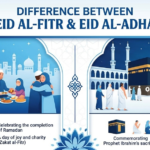
Some beginners confuse Eid al-Adha with Eid al-Fitr, or they assume the holiday is only about animal sacrifice. In reality, the festival is much broader. Many beginners also look for the Difference between Eid al-Fitr and Eid al-Adha to better understand Islamic celebrations. Understanding this distinction helps clarify the unique purpose of each festival in Islam.
Here are a few common misunderstandings:
- It is only a cultural event.
No, it is a religious festival with clear Qur’anic and Prophetic roots. - The sacrifice is the main goal.
No, the main goal is taqwa and obedience to Allah. - It is only for pilgrims.
No, Muslims everywhere celebrate Eid al-Adha. - It is about violence.
No, it is about worship, mercy, gratitude, and lawful sacrifice.
Understanding these points helps present the Eid al-Adha in a clear and accurate way.
A Brief Reflection on Faith and Submission
The story of Ibrahim (AS) and Ismail (AS) stands as one of the greatest examples of submission to Allah in Islamic teaching. It tells believers that true faith is not only spoken, but lived. It also teaches that the commands of Allah always carry wisdom, even when the wisdom is not immediately visible. For those continuing their learning journey, Online Quran Courses can help turn this reflection into consistent study and practice.
This is why the Qur’an presents the story with such dignity and emotional depth. The message is timeless: when a believer submits to Allah sincerely, Allah’s mercy always follows.
Conclusion
So, what is Eid al-Adha? It is the Islamic Festival of Sacrifice, a major occasion that honors the faith of Prophet Ibrahim (AS), the obedience of Ismail (AS), and the mercy of Allah. For beginners, the easiest way to understand it is to remember that Eid al-Adha is about more than sacrifice. It is about devotion, gratitude, charity, and trust in Allah’s wisdom.
The festival brings together prayer, remembrance, family, and generosity. It also reminds Muslims that the best worship is the kind that transforms the heart and improves behavior. Whether viewed through a traditional Islamic lens or studied in a wider historical context, Eid al-Adha remains one of the most meaningful celebrations in Islam.
If guided learning is the next step, Online Quran Teachers can provide the personal support many learners need. For families and students who want to deepen their understanding of the Qur’an and Islamic practice, Najam Academy continues to serve as a leading online Quran academy in the USA and UK, with affordable packages and global reach.
Educational Disclaimer:
This article is for educational purposes only and does not constitute a fatwa. Please consult qualified scholars for personal rulings.
References
Quran
- Quran 37:102
- Quran 37:107
- Quran 6:162
- Quran 22:37
Hadith
- Sahih al-Bukhari 5545
- Sahih al-Bukhari 5561
- Sahih al-Bukhari 5565
About the Author:
With over 18 years of experience in Islamic education and teaching, I have dedicated my work to helping students and readers develop a deeper understanding of Islam through authentic knowledge and practical guidance. My studies include Quran, Hadith, Aqeedah, Seerah, and Islamic history under qualified scholars, with a strong focus on presenting classical Islamic teachings in a clear, balanced, and accessible way for modern audiences. Through years of teaching, curriculum development, and educational mentoring, I aim to make Islamic learning engaging, reliable, and spiritually enriching for students of all ages.
Syed Fawwad Ahmed