Starting With The Name Of Almighty Allah
Surah Fatiha is called Ummul Quran for profound reasons rooted in Islamic teachings, serving as the foundational chapter that captures the essence of the entire Holy Book. This opening surah, with its seven verses, holds a unique position in the Quran, often referred to as the “Mother of the Quran” due to its comprehensive summary of core Islamic principles. Understanding the Ummul Quran’s meaning reveals how it encompasses themes of praise, guidance, and mercy, making it indispensable for Muslims worldwide. Similarly, the Ummul Kitab meaning highlights its role as the “Mother of the Book,” symbolizing the origin from which all Quranic wisdom flows. In this article, we’ll explore these aspects with credible references from the Quran and authentic hadiths, shedding light on their timeless significance.
What Does Ummul Quran Mean? Explaned
The term Ummul Quran translates to “Mother of the Quran,” a title that underscores Surah Fatiha’s central role in Islamic scripture. In Arabic, “Umm” implies something foundational or essential, much like a mother who nurtures and originates life. Scholars explain that this surah acts as the core from which the rest of the Quran expands, containing the fundamental elements of faith in a concise form.
This designation is not arbitrary; it reflects how Surah Fatiha encapsulates key doctrines such as Tawhid (the Oneness of God), worship, and the plea for divine guidance. For instance, its verses praise Allah as the Lord of the Worlds and seek the straight path, mirroring the broader messages throughout the Quran.
To deepen your understanding of foundational Islamic texts, consider exploring What is the Quran? What are some major themes in the Quran? This can provide context on how Surah Fatiha fits into the larger divine revelation. For those interested in structured learning, enrolling in Online Classes of Quran offers a convenient way to study these concepts at your own pace, with expert guidance to ensure accurate interpretation.
Historical Context of Surah Fatiha’s Revelation
Surah Fatiha was revealed in Mecca during the early stages of Prophethood, setting the tone for the entire Quran. Its placement as the first chapter is deliberate, symbolizing the beginning of guidance for humanity. The surah’s revelation aligns with the gradual unfolding of the Quran, emphasizing themes of mercy and direction from the outset.
This early revelation highlights Surah Fatiha’s importance as a comprehensive introduction to Islamic beliefs. It serves as a bridge between divine commands and human supplication, making it a cornerstone for spiritual growth.
If you’re curious about the phased nature of Quranic revelations, check out Why Was The Quran Revealed In Stages? Timeline of the Quranic Revelation. Such insights can enhance appreciation for Surah Fatiha’s timely emergence.
Why Is Surah Fatiha Called Ummul Quran?
Surah Fatiha is called Ummul Quran primarily because it summarizes the entire Quran’s teachings in just seven verses. It covers essential aspects like praising Allah, acknowledging His sovereignty, and seeking guidance on the straight path, which are recurrent themes across the Quran’s 114 chapters.
According to traditional Islamic scholarship, this surah is the essence from which all other revelations derive their meaning. For example, it includes the principles of divinity, prophethood, and the hereafter, making it a microcosm of the Holy Book.
It is reported that the Prophet Muhammad (peace be upon him) said: “Al-Hamdu lillahi Rabbil-`Alamin is the Mother of the Qur’an, the Mother of the Book, and the seven repeated Ayat of the Glorious Qur’an.” (At-Tirmidhi, graded Sahih).
This hadith emphasizes its foundational status. Additionally, Surah Fatiha’s recitation is mandatory in every unit of prayer, reinforcing its maternal role in nurturing faith.
For a detailed look at this surah’s core elements, refer to What Is Surah Al-Fatiha? Meaning, Themes & Importance. It breaks down its structure in an accessible manner. Platforms offering Quran Learning Classes often focus on such explanations, allowing students to memorize and reflect on these verses effectively.
The Connection to Quran 15:87 Explanation
A key Quranic reference supporting Surah Fatiha’s title as Ummul Quran is found in Quran 15:87, which states:
“And We have certainly given you, [O Muhammad], seven of the often repeated [verses] and the great Qur’an.” (Quran 15:87).
Scholars interpret the “seven often repeated verses” as referring to Surah Fatiha’s seven ayahs, known as As-Sab’ al-Mathani. This verse highlights its distinction and elevation above other chapters, linking it directly to the “great Quran” as its foundational component.
This explanation underscores Surah Fatiha’s significance, as it is repeatedly recited in daily prayers, embodying the repetitive nature mentioned in the ayah.
From a historical perspective, academic analyses view this as evidence of the surah’s liturgical importance in early Islamic practice, while traditional beliefs emphasize its divine selection as the Quran’s opener.
To explore its strategic position, consider Why Surah Fatiha Is the Opening of the Qur’an (The Placement of Surah Fatiha in the Qur’anic Compilation). This can clarify compilation processes. Dedicated Quran Classes Online can help unpack such verses through expert-led discussions.
Other Surah Fatiha Names and Their Implications
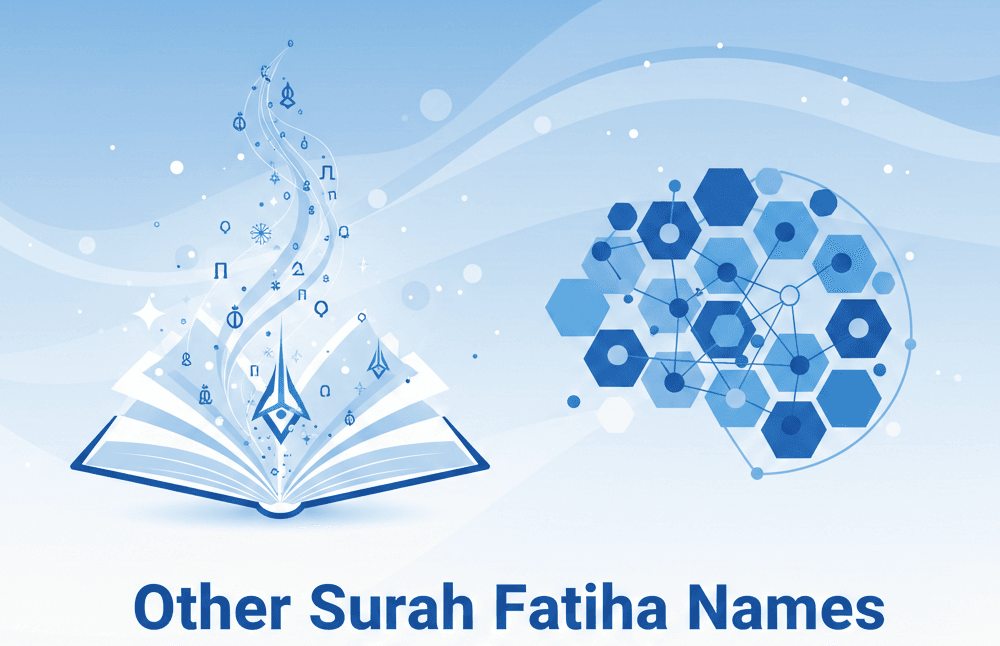
Surah Fatiha boasts multiple names, each revealing a facet of its depth. Besides Ummul Quran, it is called Al-Hamd (The Praise), As-Salah (The Prayer), Ash-Shifa (The Cure), and Umm al-Kitab (Mother of the Book). These Surah Fatiha names reflect its multifaceted role: Al-Hamd for its opening praise of Allah, As-Salah for its indispensability in prayer, and Ash-Shifa for its healing properties as mentioned in hadiths.
| Name | Arabic | Meaning | Emphasis |
| Al-Fatiha | الفاتحة | The Opening | Position and function |
| Umm al-Quran | أم القرآن | Mother of the Quran | Comprehensive nature |
| Umm al-Kitab | أم الكتاب | Mother of the Book | Foundational status |
| As-Sab al-Mathani | السبع المثاني | Seven Oft-Repeated | Liturgical importance |
| Al-Hamd | الحمد | The Praise | Central theme |
| Ash-Shifa | الشفاء | The Healing | Spiritual benefit |
| Al-Wafiya | الوافية | The Complete | Comprehensive content |
The Umm al Kitab meaning aligns closely with Ummul Quran, signifying the scriptural foundation. These titles collectively illustrate Surah Fatiha’s importance in both spiritual and practical contexts.
Abu Hurayrah narrated that the Messenger of Allah (peace be upon him) said: “It is Umm Al-Qur’an, the seven repeated (verses) and the Glorious Qur’an.” (Imam Ahmad).
For a concise overview, see Summary of Surah Fatiha (Simple Explanation), which simplifies its content for beginners. Joining an Online Quran Academy provides resources to learn these names through engaging curricula.
Surah Fatiha Significance in Daily Worship
The Surah Fatiha significance extends deeply into Muslim daily life, particularly in Salah (prayer), where its recitation is obligatory for the prayer’s validity.
It fosters a direct dialogue between the worshipper and Allah, as per a Hadith Qudsi:
“I have divided the prayer between Me and My servant into two halves, and My servant shall have what he asks for…” (Sahih Muslim).
This interactive element enhances spiritual connection, making it a pillar of devotion.
Historically, academics note its role in unifying early Muslim communities through standardized worship, while traditional views see it as a source of barakah (blessings).
Delving into its layers, The Spiritual Meaning Behind Each Verse of Surah Fatiha offers profound insights into personal reflection. Online Quran School programs often incorporate practical recitation tips to integrate this surah seamlessly into routines.
Prophetic Traditions Supporting the Title
Authentic Hadith Evidence
The Prophet Muhammad (peace be upon him) directly referred to Surah Al-Fatiha as “Umm al-Kitab” (Mother of the Book) in authentic hadith literature:
“It is Umm al-Quran, and it is Umm al-Kitab, and it is the Seven Oft-Repeated Verses.” – Sahih al-Bukhari 4474
This prophetic statement establishes multiple names for the chapter, with “Umm al-Kitab” being explicitly mentioned. The hadith demonstrates that the title “Mother of the Quran” has direct prophetic authentication, making it an authoritative designation rather than merely a scholarly interpretation.
Another significant narration further emphasizes this point:
“Al-Hamdu lillahi rabbil-alameen (All praise is due to Allah, Lord of the worlds) is Umm al-Quran, Umm al-Kitab, and As-Sab al-Mathani.” – Sunan at-Tirmidhi 2875
The Significance of Prophetic Naming
The fact that the Prophet himself used this terminology carries immense weight in Islamic tradition. Prophetic statements regarding Quranic interpretation hold special authority, as they provide divine guidance for understanding scriptural meaning. Those enrolled in Online Quran Classes often study these hadith to understand how prophetic tradition illuminates Quranic significance.
The multiple names mentioned in these narrations—Umm al-Quran, Umm al-Kitab, and As-Sab al-Mathani—each highlight different aspects of the chapter’s importance while reinforcing its comprehensive nature. Quran Online Courses can guide learners on harnessing these virtues through regular practice.
Different Perspectives on Umm al-Quran
Traditional Islamic beliefs view Umm al-Quran as divinely ordained, representing the Quran’s heart based on prophetic traditions and scholarly consensus.
In contrast, historical and academic approaches analyze it through textual criticism, examining its linguistic structure and evolution in Islamic exegesis, while respecting its sacred status.
Both perspectives agree on its centrality, though traditional ones prioritize spiritual application, and academic ones focus on cultural impact.
References for Umm al-Quran include the aforementioned Quranic verse and hadiths, ensuring a balanced understanding. Quran Online Lessons facilitate discussions on these viewpoints in a supportive environment.
Modern Relevance:
Understanding why Surah Fatiha is called Ummul Quran remains highly relevant for contemporary Muslims seeking to deepen their relationship with the Quran. In an age where Muslims often struggle to find time for extensive Quranic study, recognizing this chapter as the “Mother of the Quran” provides an efficient entry point for accessing essential Islamic wisdom.
The title encourages Muslims to approach their daily recitation of Al-Fatiha with greater consciousness and appreciation. Rather than viewing it as routine repetition, believers can understand each recitation as engagement with the core message of their faith.
Educational Applications:
Contemporary Islamic education programs worldwide utilize this understanding to structure their curricula. Students beginning Quranic study often spend considerable time mastering Al-Fatiha’s meanings and implications before progressing to other chapters.
This pedagogical approach proves particularly valuable in contexts where students have limited time for religious education. By thoroughly understanding the “Mother of the Quran,” students develop a solid foundation that enhances their comprehension of subsequent Quranic study.
The Surah Fatiha’s importance in contemporary education extends to both traditional Islamic institutions and modern online learning platforms, where this foundational understanding shapes effective teaching methodologies.
Conclusion
The title “Ummul Quran” reflects Surah Al-Fatiha’s foundational importance and comprehensive nature. Rooted in prophetic traditions, Quranic references, and scholarly consensus, it highlights the chapter’s role as both source and summary of essential Islamic teachings.
Understanding this designation deepens appreciation for the seven verses, showing that Al-Fatiha is more than routine recitation—it provides the spiritual framework for righteous living. Regular engagement with the “Mother of the Quran” allows believers to access the core wisdom of the entire scripture and strengthen their connection with faith.
For those seeking to explore these profound concepts further and develop comprehensive understanding of Quranic teachings, Najam Academy offers exceptional online education programs. As a leading online Quran Academy serving students across the USA, UK, and internationally, Najam Academy provides expert instruction with affordable packages designed to make authentic Islamic education accessible to learners worldwide. Through structured courses and personalized guidance, students can deepen their understanding of why Surah Al-Fatiha holds the honored title of “Mother of the Quran” and develop lasting connections with Islamic wisdom.
Educational Disclaimer: This article is for educational purposes only and does not constitute a fatwa. Please consult qualified scholars for personal religious rulings and specific guidance on Islamic matters.
References Used
Quranic Verse:
- Quran 15:87
Ahadees:
- At-Tirmidhi (Sahih),
- Imam Ahmad,
- Sahih Muslim,
- Sahih al-Bukhari 4474
About the Author:
As a specialist in Quran Education and Tafseer, I’ve spent over a decade designing curricula and teaching interpretation that bridges classical scholarship with contemporary contexts. Trained in Usul al-Tafsir and Ulum al-Qur’an under qualified scholars, my approach combines rigorous textual analysis with clear, practical guidance to ensure an accurate, context-rich understanding for readers.
Abdul Hafeez