Starting With The Name Of Almighty Allah Ever
Surah Fatiha, the opening chapter of the Quran, holds a central place in Islamic worship, recited in every unit of prayer. Its verses encapsulate profound supplications, guiding believers toward divine mercy and the straight path. Among its concluding lines is a plea that resonates deeply: a request for guidance on the path of the favored, while avoiding the ways of those who have incurred divine displeasure or strayed. This brings us to the core inquiry—who are ‘those who have earned God’s anger’ in Surah Fatiha? Exploring this reveals layers of spiritual wisdom, drawing from authentic Islamic sources to illuminate the meaning behind these words.
The phrase “ghayril maghdoobi alayhim” translates to “not of those who have evoked [Your] anger,” part of the verse that contrasts the straight path with paths of deviation. Understanding this not only enriches one’s recitation but also serves as a reminder of the consequences of straying from truth. As learners delve into Quranic guidance, this exploration highlights the importance of seeking knowledge to align one’s life with divine will.
Breaking Down the Verse: Surah Fatiha Last Verses Meaning
Surah Fatiha culminates in verses 6 and 7, where the believer implores:
“Guide us to the straight path—the path of those upon whom You have bestowed favor, not of those who have evoked [Your] anger or of those who are astray.”
(Quran 1:6-7)
These words form a dua, or supplication, that divides humanity into three categories: the favored, those who earned Allah’s anger, and the astray. The favored are often identified as prophets, truthful ones, martyrs, and the righteous, as elaborated in other Quranic verses. In contrast, the latter two groups represent pitfalls to avoid.
The Arabic structure here is precise. “Ghayril maghdoobi alayhim” uses a passive form, indicating those upon whom anger has been earned through their actions. This implies accountability—anger is not arbitrary but a response to deliberate choices. Meanwhile, “walad dhalleen” refers to those who have gone astray, suggesting a state of wandering without firm guidance.
To grasp this fully, consider the linguistic nuance. “Maghdoob” derives from “ghadab,” meaning intense displeasure, often linked to rebellion against known truths. This verse’s placement at the end of Surah Fatiha underscores a complete prayer cycle: praise, acknowledgment of sovereignty, commitment to worship, and finally, a plea for steadfastness.
For those embarking on structured Quranic study, resources like Online Classes of Quran at Najam Academy offer in-depth breakdowns of such verses, helping students connect linguistic elements with spiritual applications. These sessions often include recitation practice to ensure accurate pronunciation and comprehension.
Tafsir of Ghayril Maghdoob Alayhim: Scholarly Interpretations
Tafsir, or exegesis, provides essential insights into the Quran’s meanings. Major scholars like Ibn Kathir and At-Tabari have expounded on this verse, drawing from prophetic traditions.
According to Ibn Kathir, “those who have earned Your anger” primarily refers to groups who knew the truth but deviated from it, corrupting their intentions and abandoning righteous practice. This is supported by a hadith where the Prophet Muhammad (peace be upon him) clarifies the identities.
“Adi bin Hatim reported: The Messenger of Allah (peace be upon him) said, ‘Those who have earned the anger are the Jews, and those who are led astray are the Christians.'”
(Jami’ at-Tirmidhi 2954)
This narration, graded as hasan (good) by At-Tirmidhi, highlights historical examples. The Jews, in this context, are cited for recognizing divine signs but rejecting them out of envy or alteration of scriptures. Quran verses reinforce this:
“So they have drawn on themselves wrath upon wrath.”
(Quran 2:90)
“Say, ‘Shall I inform you of [what is] worse than that as penalty from Allah? [It is that of] those whom Allah has cursed and with whom He became angry…'”
(Quran 5:60)
Scholars emphasize that this is not a blanket condemnation but a warning against similar behaviors, such as knowingly forsaking obligations. At-Tabari echoes this, noting that anger descends on those who persist in disobedience despite guidance.
In exploring foundational texts, topics like What is the Quran? What are some major themes in the Quran? provide broader context, revealing how Surah Fatiha ties into overarching themes of monotheism and accountability.
Who Are the Maghdoob? Identifying Those Who Earned Allah’s Anger
The term “maghdoob alayhim” encapsulates those who invoke divine anger through willful rebellion. Traditional tafsir points to the Jews as an archetype, not due to ethnicity, but because of specific actions recounted in the Quran.

For instance, the incident of the golden calf illustrates this:
“Indeed, those who took the calf [for worship] will obtain [as penalty] anger from their Lord and humiliation in the life of this world…”
(Quran 7:152)
Here, despite receiving clear miracles through Prophet Moses (peace be upon him), some turned to idolatry. This pattern—receiving knowledge yet distorting or rejecting it—earns anger. Ibn Abbas, a companion of the Prophet, reportedly said that the maghdoob are those whose deeds are corrupt despite their knowledge.
However, this extends beyond one group. Any believer who knowingly neglects duties, such as prayer or justice, risks falling into this category. The Prophet warned against such hypocrisy in a hadith:
“The Messenger of Allah (peace be upon him) said, ‘There are two characteristics that are not combined in a believer: miserliness and bad character.'”
(Jami’ at-Tirmidhi 1962)
This underscores personal reflection. To avoid this path, one must align actions with faith.
Programs such as Online Quran Classes at Najam Academy emphasize practical application, teaching how to internalize these warnings through daily reflection and study groups.
Maghdoob Alayhim’s Explanation: Broader Implications
Delving deeper into the meaning of maghdoob alayhim, it represents a state where divine favor is withdrawn due to persistent transgression. Unlike temporary sins forgiven through repentance, this anger stems from hardened hearts.
Quranic narratives abound with examples. The people of Pharaoh earned anger for oppressing the Israelites despite signs:
“So when they angered Us, We took retribution from them and drowned them all.”
(Quran 43:55)
Scholars like Al-Qurtubi note that anger manifests in worldly humiliation and afterlife punishment. Yet, mercy remains accessible via sincere tawbah (repentance).
In a hadith, the Prophet illustrates Allah’s responsiveness:
“Abu Hurairah reported: The Messenger of Allah (peace be upon him) said, ‘Allah Almighty said: I have divided prayer between Myself and My servant… When he says, “Not [the path] of those who have evoked [Your] anger, nor of those who are astray,” Allah says, “This is for My servant, and My servant shall have what he has asked for.”‘”
(Sahih Muslim 395)
This dialogue in prayer reminds us that seeking to avoid these paths invites divine aid.
For nuanced understanding, discussions on Can the Quran be translated? How To Translate, without hurting Its Effectiveness highlight why original Arabic preserves such depths, encouraging learners to study in native terms. For structured progress, Online Quran Courses at Najam Academy offer progressive modules, from basics to advanced tafsir.
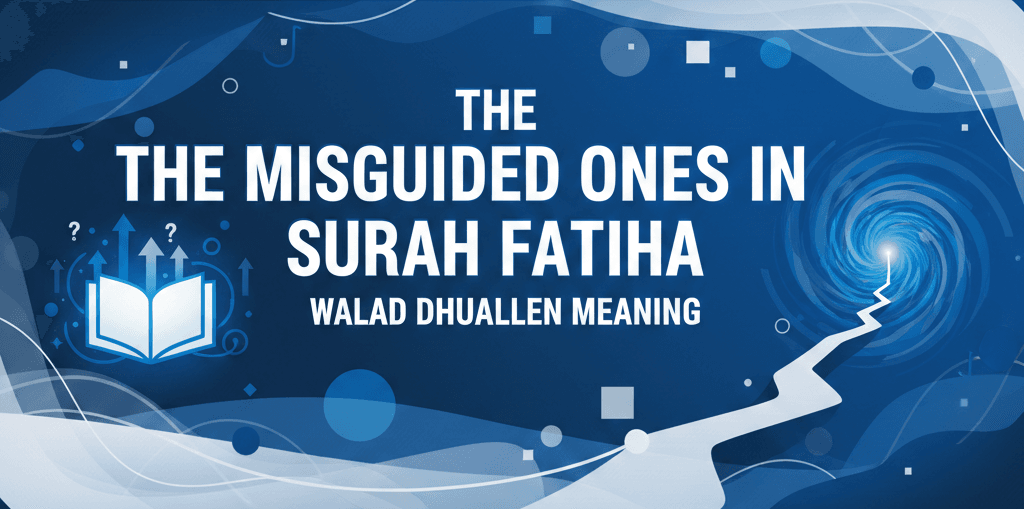
The Misguided Ones in Surah Fatiha: Walad Dhualleen Meaning
Complementing those who earned anger are “walad dhalleen,” the astray, who wander due to ignorance or misguided beliefs. Tafsir identifies Christians as an example, for altering the message of Jesus (peace be upon him), such as deifying him.
“Say, ‘O People of the Scripture, do not exceed limits in your religion beyond the truth and do not follow the inclinations of a people who had gone astray before and misled many and have strayed from the soundness of the way.'”
(Quran 5:77)
Their error lies in lacking accurate knowledge, leading to innovations like the Trinity. A hadith reinforces:
“The Messenger of Allah (peace be upon him) said, ‘The Christians are those who have gone astray.'”
(Musnad Ahmad 14667)
Again, this is exemplary—anyone following baseless desires fits this description. The astray often act with good intentions but without guidance, contrasting the maghdoob’s deliberate defiance.
To counter this, the Quran urges seeking knowledge:
“So know that there is no deity except Allah and ask forgiveness for your sin…”
(Quran 47:19)
Structured learning through Quran Learning Classes at Najam Academy helps prevent straying by building a strong foundational understanding of core beliefs.
Straight Path vs Misguided Meaning: Contrasting Paths in Surah Fatiha
The “sirat al-mustaqeem” (straight path) is the balanced way of the favored—prophets like Muhammad (peace be upon him), Abraham (peace be upon him), and their followers. It avoids extremes: neither the anger-provoking rebellion nor the astray’s confusion.
This contrast teaches equilibrium. The straight path involves knowledge plus action, as per:
“And [mention] when Abraham said, ‘My Lord, show me how You give life to the dead.’ [Allah] said, ‘Have you not believed?’ He said, ‘Yes, but [I ask] only that my heart may be satisfied.'”
(Quran 2:260)
Misguided paths deviate through excess or deficiency. A table illustrates key differences:
| Path Category | Characteristics | Examples from Tafsir |
| Straight Path (Sirat al-Mustaqeem) | Knowledge + Righteous Action; Balance in Faith | Prophets, Truthful, Martyrs, Righteous (Quran 4:69) |
| Those Who Earned Anger (Maghdoob) | Knowledge Without Action; Deliberate Deviation | Archetypal: Jews who rejected truths (Quran 5:60) |
| The Astray (Dhalleen) | Action Without True Knowledge; Ignorance-Led Errors | Archetypal: Christians with doctrinal innovations (Quran 5:77) |
This framework encourages self-assessment. The Prophet advised:
“The Messenger of Allah (peace be upon him) said, ‘Straighten your rows, or Allah will alter your faces.'”
(Sahih al-Bukhari 717)
Symbolically, alignment in prayer mirrors life’s straight path.
Insights from What Is Surah Al-Fatiha? Meaning, Themes & Importance further elucidate how this surah’s structure mirrors the believer’s journey toward guidance.
Significance of These Verses in Daily Life and Worship
Reciting Surah Fatiha daily reinforces avoidance of these paths. It fosters humility, prompting reflection on personal flaws.
Practically, it guides routine-building: Start days with Fatiha’s contemplation to align intentions. In community, it promotes unity, warning against division.
A hadith emphasizes its protective role:
“The Messenger of Allah (peace be upon him) said, ‘Surah Fatiha is a cure for every disease.'”
(Sunan ad-Darimi 3373)
Spiritually, it builds consistency—benefits include heightened awareness, better decision-making, and stronger faith.
For those seeking to integrate this, Online Quran Learning at Najam Academy provides interactive sessions on applying tafsir to modern challenges, enhancing spiritual routines.
Exploring Related Verses and Themes in the Quran
Surah Fatiha’s themes echo throughout the Quran. For instance, the favored path links to:
“And whoever obeys Allah and the Messenger – those will be with the ones upon whom Allah has bestowed favor of the prophets, the steadfast affirmers of truth, the martyrs and the righteous. And excellent are those as companions.”
(Quran 4:69)
Anger and straying appear in stories like Noah’s people or Lot’s, showing universal lessons.
Understanding these connections deepens appreciation. The plea “iyyaka na’budu wa iyyaka nasta’een” (You alone we worship and You alone we ask for help) precedes this, emphasizing reliance on Allah to stay guided.
Related explorations in The Spiritual Meaning Behind Each Verse of Surah Fatiha offer verse-by-verse insights, revealing interconnected spiritual layers.
The favored ones represent the spiritual ideal, standing in direct contrast to the maghdoob (those who earned anger) and the dhalleen (those who went astray) by embodying success through divine grace; according to Surah An-Nisa 4:69, this elite group is specifically identified as the Prophets, the Sincere, the Martyrs, and the Righteous.
This group serves as a living blueprint for believers to emulate, demonstrating that the path to divine favor is paved with unwavering patience (sabr), selfless charity, and total devotion; by internalizing these virtues, one transforms the dua of Surah Fatiha from a ritual recitation into a conscious commitment to spiritual excellence.
Related content in The Meaning of “Sirat al-Mustaqeem” Explained details the straight path’s attributes, complementing avoidance of misguided ways.
Historic Islamic Beliefs on These Groups
In traditional Islamic scholarship, the maghdoob and dhalleen are viewed as cautionary examples from past nations. Scholars like Ibn Taymiyyah stress learning from their errors without animosity, promoting interfaith respect.
This perspective fosters tolerance, as the Quran instructs:
“There shall be no compulsion in [acceptance of] the religion…”
(Quran 2:256)
It encourages dawah (invitation) through good character.
Historically, interpretations evolved with cultural contexts. Early tafsir focused on prophetic explanations, while medieval scholars like Ar-Razi incorporated philosophical angles, viewing anger as metaphorical for divine justice.
Academically, modern studies examine socio-historical factors. For example, some researchers note how these descriptions addressed 7th-century Arabian interactions with Jews and Christians, urging Muslims to forge a distinct path.
Neutrally, these approaches highlight the Quran’s timeless relevance—anger and straying as human tendencies, not fixed to groups. Respectful dialogue acknowledges diversity in exegesis.
For deeper dives, The Hidden Depth Behind “Iyyaka Na’budu wa Iyyaka Nasta’een” unpacks preceding verses, showing how they set the stage for this plea. Enrolling in our Online Quran Academy programs can help learners grasp these beliefs through classical texts, guided by experienced instructors.
Practical Guidance: Avoiding the Paths of Anger and Misguidance
To steer clear, cultivate knowledge and action. Steps include:
- Regular Quran study to internalize truths.
- Sincere repentance for lapses.
- Seeking scholarly advice for doubts.
- Community involvement for accountability.
Benefits: Enhanced spiritual resilience, better relationships, and inner peace.
A hadith guides:
“The Messenger of Allah (peace be upon him) said, ‘The strong believer is better and more beloved to Allah than the weak believer, although both are good. Strive for that which will benefit you…'”
(Sahih Muslim 2664)
Online platforms like Najam Academy, which is basically an Online Quran school, facilitate this through tailored courses, making guidance accessible worldwide.
Building Consistency in Quranic Reflection
Routine reflection on Fatiha transforms recitation into meditation. Start with short daily sessions, journaling insights.
Consistency yields spiritual growth, as the Prophet noted:
“The most beloved deeds to Allah are those done continuously, even if small.”
(Sahih al-Bukhari 6464)
In today’s world, these verses warn against modern pitfalls like materialism (straying) or hypocrisy (anger). They promote ethical living amid challenges. Benefits include moral clarity and resilience. Programs via Quran Online Lessons at Najam Academy, adapt these teachings to contemporary issues, fostering relevant application.
Conclusion
Surah Fatiha’s plea to avoid those who earned Allah’s anger and the astray encapsulates a timeless call for guidance. By understanding “ghayril maghdoobi alayhim walad dhalleen” through tafsir and hadith, believers gain tools to navigate life’s paths. This exploration reminds us that divine anger stems from deliberate deviation, while straying arises from ignorance—both avoidable through knowledge, action, and sincerity. Ultimately, it invites a deeper commitment to the straight path, enriching worship and daily life.
As you pursue further Quranic insights, consider the comprehensive offerings from Najam Academy. As a leading online Quran Academy in the USA & UK, Najam Academy provides affordable packages with experienced instructors, reaching students globally to nurture authentic understanding and spiritual growth.
Educational Disclaimer:
This article is for educational purposes only and does not constitute a fatwa. Please consult qualified scholars for personal rulings.
References Used
Quranic Verses:
- Quran 1:6-7
- Quran 1:7
- Quran 2:90
- Quran 2:256
- Quran 2:260
- Quran 4:69
- Quran 5:60
- Quran 5:77
- Quran 7:152
- Quran 43:55
- Quran 47:19
Hadith References:
- Jami’ at-Tirmidhi 2954
- Jami’ at-Tirmidhi 1962
- Sahih Muslim 395
- Musnad Ahmad 14667
- Sahih al-Bukhari 717
- Sunan ad-Darimi 3373
- Sahih Muslim 2664
- Sahih al-Bukhari 6464
About the Author:
As a specialist in Quran Education and Tafseer, I’ve spent over a decade designing curricula and teaching interpretation that bridges classical scholarship with contemporary contexts. Trained in Usul al-Tafsir and Ulum al-Qur’an under qualified scholars, my approach combines rigorous textual analysis with clear, practical guidance to ensure accurate, context-rich understanding for readers.
Abdul Hafeez