Starting With The Name Of Almighty Allah
In a world where interfaith dialogue bridges gaps between religions, many seekers turn to sacred texts for common ground. A frequent query arises: what the Quran says about the Bible? As the holy book of Islam, the Quran references previous scriptures like the Torah and Gospel, affirming their divine origins while addressing changes over time. This exploration delves into does the Quran accept the Bible, offering insights into Quranic verses about the Bible and broader themes. Whether you’re curious about Islam’s view on the Bible or pondering does Islam believe in the Bible, understanding these connections fosters respect and knowledge. We’ll examine traditional Islamic interpretations alongside historical and academic perspectives to provide a balanced view.
The Quran’s Recognition of Previous Revelations
At its core, the Quran positions itself as the final revelation in a chain of divine messages sent to humanity. It explicitly acknowledges the scriptures given to earlier prophets, including those associated with the Bible. Traditional Islamic belief sees this as a confirmation of unity in monotheism, where Allah revealed guidance progressively through Moses, Jesus, and others before Muhammad (PBUH).
From a historical standpoint, scholars note that the Quran was revealed in 7th-century Arabia, a region influenced by Jewish and Christian communities. This context shaped its references, aiming to correct misconceptions while validating authentic elements of prior texts. Academically, this reflects a dialogic approach, engaging with existing religious narratives to establish Islam’s continuity.
One key verse highlights this affirmation:
“We have revealed to you [O Muhammad] the Book in truth, confirming that which preceded it of the Scripture and as a criterion over it.”
(Quran 5:48)
This suggests the Quran serves as a guardian or judge over earlier revelations, implying both confirmation and clarification.
For those new to these concepts, starting with basics can help. Our guide on What is the Quran? What are some major themes in the Quran? breaks down its foundational ideas, making it easier to grasp these intertextual references. To dive deeper into structured study, consider enrolling in Online Classes of Quran, where instructors explain such verses in context.
Does the Quran Accept the Bible? Insights from Key Verses
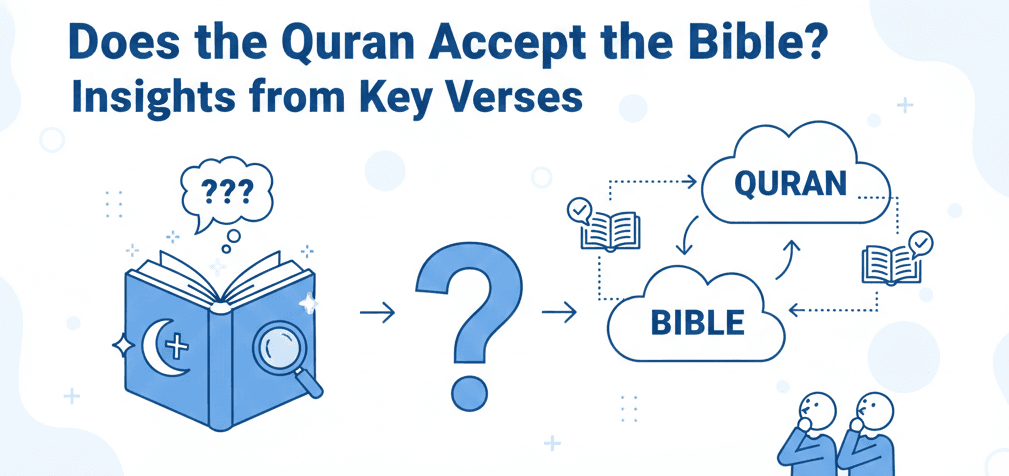
The relationship between the Quran and the Bible represents one of Islam’s most nuanced theological positions. Yes, the Quran fundamentally accepts the Bible—but with important theological distinctions. The Quran consistently commands belief in all divine scriptures, explicitly honoring the Torah (Tawrat) given to Moses and the Gospel (Injil) revealed to Jesus as authentic lights of divine guidance. These texts are recognized as genuine revelations from Allah, sent to guide the Children of Israel and early Christian communities. However, the Quran makes a crucial differentiation between the original, pristine messages as they were first revealed and the current biblical texts, suggesting that alterations may have occurred over centuries of transmission. This perspective doesn’t reject the Bible outright but rather calls for discerning study, encouraging Muslims to recognize the divine origins while understanding potential human modifications through historical manuscript variations.
Traditional teachings emphasize that Muslims must accept these scriptures in their original forms as true revelations from God. However, it distinguishes between the pristine messages and potential alterations.
Historically, academic analyses point to textual variations in biblical manuscripts over centuries, which align with Quranic warnings about changes. This perspective encourages comparative study without dismissing the Bible outright.
Consider this directive:
“Say, ‘O People of the Scripture, you are [standing] on nothing until you uphold [the law of] the Torah, the Gospel, and what has been revealed to you from your Lord.'”
(Quran 5:68)
Here, the Quran calls for adherence to these texts, underscoring their validity when followed correctly.
Another verse reinforces this:
“And let the People of the Gospel judge by what Allah has revealed therein. And whoever does not judge by what Allah has revealed—then it is those who are the defiantly disobedient.”
(Quran 5:47)
These passages illustrate what the Quran says about Torah and Gospel, treating them as authoritative sources.
If authenticity concerns intrigue you, explore How do we know the Quran is authentic? for parallels in preservation discussions.
Islam’s View on the Bible: Affirmation and Caution
Islam maintains a carefully balanced perspective on the Bible, characterized by respectful recognition coupled with theological caution. Muslims are instructed to honor the Bible as containing authentic divine revelations—particularly the original Torah and Gospel—while simultaneously relying on the Quran as their primary source of guidance. This dual approach stems from the Islamic concept of tahrif (textual alteration), which suggests that human intervention may have modified the original biblical messages over time. Consequently, Muslims view the Bible as containing remnants of divine truth embedded within texts that may have experienced historical changes, requiring discernment to distinguish between original revelation and later modifications.
In traditional circles, this view protects the Quran’s role as the unaltered word. Academically, historians examine how oral traditions and translations could lead to divergences, offering a scholarly lens on inter-scriptural relations.
A Hadith from the Prophet (PBUH) advises caution in engagement:
“Do not believe the People of the Book, nor disbelieve them, but say, ‘We believe in Allah and whatever is revealed to us.'”
(Sahih al-Bukhari:4485)
This promotes a balanced stance, neither wholesale acceptance nor rejection. For practical learning, Online Quran Classes often include modules on comparative religion, helping students navigate these views.
Is the Bible Changed According to the Quran?
One of the most debated topics in interfaith dialogue is is the Bible corrupted according to the Quran? The Quran presents a nuanced perspective, suggesting that certain portions of previous scriptures were altered or misinterpreted by people over time through selective editing and deliberate concealment. Specific verses like Quran 2:79 and 4:46 accuse some groups of “writing the book with their own hands” and attributing it to Allah for worldly gain. However, the Quran doesn’t claim wholesale corruption of the entire Bible, but rather points to targeted modifications and interpretive manipulations that served particular religious or political agendas.
Traditional Islamic scholars, particularly figures like Ibn Taymiyyah, have developed sophisticated interpretive frameworks distinguishing between tahrif al-lafz (verbal distortion of actual text) and tahrif al-ma’ani (misinterpretation of meanings while preserving original words). From an academic perspective, modern textual criticism of biblical manuscripts reveals significant variations across ancient copies, with archaeological discoveries like the Dead Sea Scrolls demonstrating textual fluidity in early Jewish and Christian communities. This scholarly evidence supports the Islamic position that changes occurred over time, though contemporary research generally attributes most variations to natural transmission processes, scribal errors, and editorial harmonization rather than systematic theological manipulation or malicious intent.
A pointed verse states:
“So woe to those who write the ‘scripture’ with their own hands, then say, ‘This is from Allah,’ in order to exchange it for a small price. Woe to them for what their hands have written and woe to them for what they earn.”
(Quran 2:79)
This warns against fabrication, implying human interference.
Another example:
“And indeed, there is among them a party who alter the Scripture with their tongues so you may think it is from the Scripture, but it is not from the Scripture.”
(Quran 3:78)
These highlight concerns without blanket condemnation.
Curious about preservation contrasts? Our piece on Why is the Quran Considered Perfectly Preserved details the meticulous process safeguarding the Quran.
Quran vs Bible Comparison: Similarities That Unite
In any Quran vs Bible comparison, remarkable similarities emerge that foster interfaith understanding and highlight shared spiritual foundations. Both scriptures emphasize strict monotheism, ethical living, and feature overlapping prophetic narratives including Abraham, Noah, Moses, and Jesus. Common themes permeate both texts: divine creation, final judgment, moral accountability, charity toward the poor, and the importance of prayer and worship. These parallel teachings demonstrate fundamental agreement on core spiritual principles, suggesting a unified divine message across different communities and historical periods.

Traditional Islamic theology interprets these convergences as evidence of a single divine source progressively revealed through different messengers. Historical scholarship traces these shared elements to common Abrahamic origins, with centuries of cultural and theological exchange enriching both traditions. The Quran often retells biblical narratives with expanded details, such as the story of Joseph, maintaining essential truths while offering different perspectives and emphasis. Quran and Bible comparison in Islam frequently highlights how the Quran confirms foundational biblical truths, including Jesus’ miraculous birth, Mary’s virginity, and various prophetic missions, as reflected in the Quran:
“We have already sent Our messengers with clear evidences and sent down with them the Scripture and the balance that the people may maintain [their affairs] in justice.”
(Quran 57:25)
This underscores the continuity of revelation.
To build on these insights, Quran Learning Classes can help you explore parallel stories interactively. If compilation processes interest you, read How Was the Qur’an Preserved? The Story of the Qur’an’s Compilation into a Single Book for a historical walkthrough.
Quran vs Bible: Differences and Their Implications
While similarities abound, Quran vs Bible similarities and differences reveal distinct theological emphases that have shaped centuries of religious thought and practice. The Quran fundamentally rejects the Christian doctrine of the Trinity, firmly affirming God’s absolute oneness (Tawhid) and presenting Jesus as a revered prophet rather than divine. Significant differences also emerge in legal frameworks, with the Quran providing detailed guidance on inheritance, marriage, and social justice, while offering different eschatological perspectives on salvation, the afterlife, and final judgment. These theological distinctions have profound implications for worship practices, community structures, and interfaith relations across both religious traditions.
The Islamic intellectual tradition attributes these differences primarily to alterations in biblical texts over time or to contextual revelations suited for different communities and historical periods. Academic approaches examine how diverse socio-political factors influenced each scripture’s development and interpretation, from Roman imperial influences on early Christianity’s doctrinal formulations to Arabian tribal customs and Byzantine-Persian geopolitical contexts that shaped Islamic legal and theological frameworks. Contemporary scholarship suggests these differences reflect natural evolution of religious thought within distinct cultural matrices, highlighting how divine messages adapt to specific communities while maintaining core spiritual principles and moral guidance.
Does the Quran say the Bible is true? It affirms original truths but questions later versions.
A clarifying verse:
“They have certainly disbelieved who say, ‘Allah is the Messiah, the son of Mary’ while the Messiah has said, ‘O Children of Israel, worship Allah, my Lord and your Lord.'”
(Quran 5:72)
This addresses doctrinal variances directly.
Another:
“And [for] their saying, ‘Indeed, we have killed the Messiah, Jesus, the son of Mary, the messenger of Allah.’ And they did not kill him, nor did they crucify him; but [another] was made to resemble him to them.”
(Quran 4:157)
These passages illustrate key divergences.
For myths around Quranic history, check Misconceptions About the Compilation of the Holy Quran to clear common doubts. Advanced learners might appreciate Quran Classes Online, focusing on comparative exegesis.
Engaging with Earlier Scriptures: An Islamic Framework
For Muslims, engaging with the Bible requires a balanced, principled approach rooted in Islamic guidance. Classical scholars advised that biblical texts (Ahl al-Kitab scriptures) may be read with discernment, neither fully accepted nor entirely rejected, but always evaluated in the light of the Quran and authentic Sunnah. The Quran itself encourages dialogue with earlier revelations while affirming its role as the final criterion (al-Furqan).
Many Muslims today find value in the Bible’s ethical narratives—such as moral accountability, compassion, and social justice—while maintaining that ultimate religious authority lies with Islamic sources. Cross-referencing biblical passages with Quranic teachings helps clarify areas of agreement, divergence, and theological development.
Historically, renowned Muslim scholars, including Imam al-Ghazali, were familiar with Judeo-Christian texts, not for theological dependence but for intellectual engagement, polemical defense, and extracting general wisdom. This scholarly openness reflected a tradition of critical study anchored firmly in Islamic creed.
In contemporary, pluralistic societies, such informed engagement promotes religious literacy, respectful dialogue, and a clearer understanding of Islamic beliefs. When approached thoughtfully, studying earlier scriptures can strengthen a Muslim’s appreciation of the Quran’s message while fostering meaningful interfaith awareness—without compromising Islamic principles.
A Hadith encourages seeking knowledge broadly:
“The word of wisdom is the lost property of the believer, so wherever he finds it, he has a better right to it.”
(Jami` at-Tirmidhi: 2687)
This supports exploring truths across texts.
Translation challenges arise in comparisons. Learn more in Can the Quran Be Translated? How to Translate Without Hurting Its Effectiveness. Engage further with Quran Online Courses tailored for comparative insights. For hands-on study, Online Quran Academy offers courses integrating these discussions.
Scholarly Perspectives on Inter-Scriptural Relations
Scholars across eras have weighed in on does Islam believe in the Bible. Classical figures like Ibn Kathir in tafsir works affirm original authenticity while noting changes. Modern thinkers, influenced by academic methods, advocate dialogue, viewing differences as opportunities for understanding.
Traditional views maintain the Quran’s supremacy, while historical lenses examine manuscript evidence for biblical evolution.
This balanced approach builds bridges without compromising faith.
If accuracy debates fascinate you, our blog on Which is more accurate Bible or Quran? provides a thoughtful comparison.
To enhance recitation skills in your studies, join Online Quran School for expert-led sessions.
Fostering Dialogue Through Shared Wisdom
Ultimately, exploring what the Quran says about the Bible enriches spiritual journeys. It reveals a tapestry of divine guidance, where affirmations and corrections guide believers toward truth.
A unifying verse:
“O mankind, indeed We have created you from male and female and made you peoples and tribes that you may know one another. Indeed, the most noble of you in the sight of Allah is the most righteous of you.”
(Quran 49:13)
This promotes mutual recognition across faiths.
For foundational questions, see Is the Quran the same as the Bible? to debunk common confusions. Daily practice deepens this. Try Quran Online Lessons to incorporate verses meaningfully.
Conclusion
In wrapping up, these explorations highlight the Quran’s respectful yet discerning stance on the Bible, inviting reflection on shared heritage. At Najam Academy, a leading online Quran academy in the USA and UK with a growing global presence, we provide the best online Quran education in affordable packages. Our dedicated tutors help you unpack these profound topics through personalized lessons, ensuring a supportive path to greater understanding and faith.
Educational Disclaimer:
This article is for educational purposes only and does not constitute a fatwa. Please consult qualified scholars for personal rulings.
References Used
Quranic Verses:
- Quran 5:48
- Quran 5:68
- Quran 5:47
- Quran 2:79
- Quran 3:78
- Quran 57:25
- Quran 5:72
- Quran 4:157
- Quran 49:13
Hadith References:
- Sahih al-Bukhari: 4485
- Jami` at-Tirmidhi: 2687
About the Author:
As a specialist in Quran Education and Tafseer, I’ve spent over a decade designing curricula and teaching interpretation that bridges classical scholarship with contemporary contexts. Trained in Usul al-Tafsir and Ulum al-Qur’an under qualified scholars, my approach combines rigorous textual analysis with clear, practical guidance to ensure accurate, context-rich understanding for readers.
Abdul Hafeez