Starting With The Name Of Almighty Allah Ever
In a world where billions turn to sacred texts for guidance, one question often sparks curiosity and debate: Is the Quran the same as the Bible? Both books hold immense significance in their respective faiths—Islam and Christianity—shaping beliefs, morals, and cultures across centuries. While they share common roots in Abrahamic traditions, exploring the Quran vs the Bible differences and similarities between the Quran and the Bible reveals a nuanced picture. This blog delves into these aspects, drawing from traditional Islamic perspectives and historical insights to provide a balanced view. Whether you’re seeking spiritual clarity or academic understanding, understanding these texts can foster greater interfaith dialogue.
Shared Foundations: Similarities Between the Quran and the Bible
At first glance, the Quran and the Bible appear connected through their emphasis on monotheism, moral living, and divine revelation. Both affirm the existence of one God, Creator of the universe, and call believers to worship Him alone. This shared belief in Bible vs Quran monotheism forms the bedrock of Abrahamic religions, with figures like Abraham (Ibrahim in Arabic) revered as a patriarch in both.
Many prophets in Quran and Bible overlap, portraying messengers sent by God to guide humanity. For instance, Noah (Nuh), Moses (Musa), and Jesus (Isa) feature prominently in both scriptures, often with parallel stories of floods, miracles, and teachings. These common narratives suggest a continuity in divine messages, inviting readers to reflect on universal truths.
From a traditional Islamic viewpoint, these similarities stem from the idea that all prophets delivered the same core message of submission to God. Historical scholars, however, point to cultural exchanges in the ancient Near East, where stories might have influenced one another through oral traditions. Regardless of the lens, these parallels encourage mutual respect among followers.
To deepen your understanding of these foundational elements, consider exploring What is the Quran? What are some major themes in the Quran?, which highlights themes like mercy and justice that echo in both texts. For those looking to study these shared stories systematically, our Online Classes of Quran provide interactive sessions led by knowledgeable instructors.
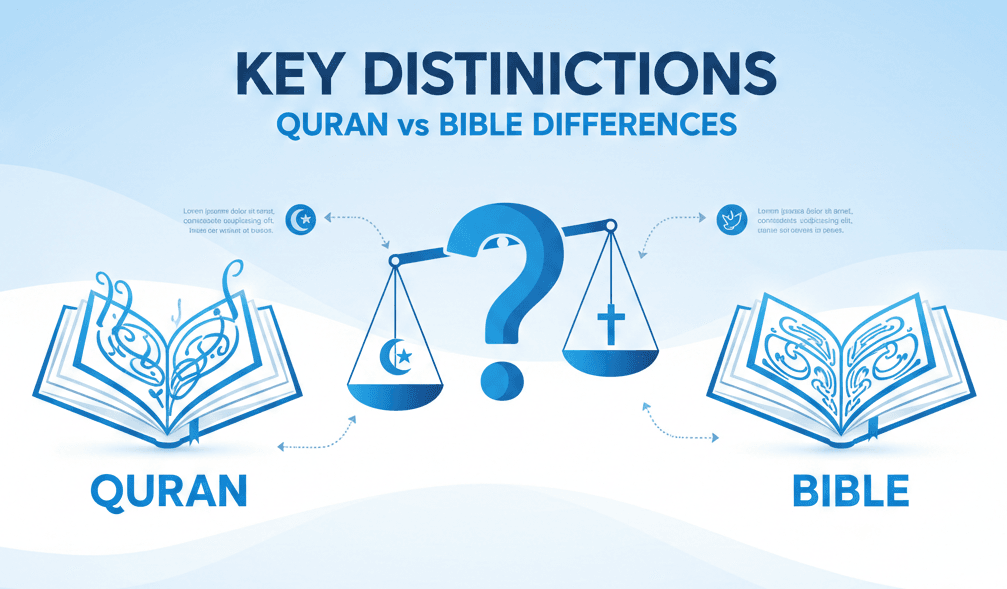
Key Distinctions: Quran vs Bible Differences
While similarities exist, the Quran vs Bible differences are profound, spanning theology, structure, and interpretation. These variances aren’t just academic; they influence how adherents live their faith daily.
Theological Variations: Salvation in Quran vs Bible
One core difference lies in concepts of salvation. The Bible, particularly in the New Testament, emphasizes faith in Jesus Christ’s sacrifice as the path to redemption from original sin. In contrast, the Quran teaches that salvation comes through sincere faith in God, good deeds, and repentance, without the notion of inherited sin.
“Indeed, those who have believed and done righteous deeds – they will have the Gardens of Paradise as a lodging.”
(Quran 18:107)
This verse underscores personal accountability, a hallmark of Islamic theology. Traditional Muslims view this as a direct, unmediated relationship with God, while academic approaches might analyze how these ideas evolved from Jewish roots shared by both texts.
If you’re interested in exploring salvation themes through guided study, our Online Quran Classes offer tailored discussions on such topics.
Prophets in Quran and Bible: Shared Yet Distinct Roles
Both scriptures honor prophets, but their portrayals differ. The Bible often includes detailed biographies with human flaws, like David’s adultery. The Quran, however, presents prophets as infallible role models, focusing on their unwavering obedience to God.
For example, the story of Abraham’s sacrifice—Isaac in the Bible, Ishmael in Islamic tradition—highlights this. Muslims see prophets as protected from major sins, aligning with the Quran’s narrative purity.
“O Messenger, announce that which has been revealed to you from your Lord. And if you do not, then you have not conveyed His message.”
(Quran 5:67)
This emphasis on prophetic integrity is central to Islam. Historical critics might argue these differences arose from redaction processes over time, but believers hold them as divinely intended. For hands-on learning about prophetic narratives, join our Quran Learning Classes to gain deeper insights.
Do Muslims Believe the Bible is Corrupted?
A pivotal question in interfaith discussions is: Do Muslims believe the Bible is corrupted? From the traditional Islamic perspective, yes—Muslims hold that the original Torah (Tawrat) revealed to Moses and the Gospel (Injil) to Jesus were pure divine words, but human alterations over centuries distorted them.
The Quran itself addresses this, urging respect for earlier scriptures while noting changes.
“And let the People of the Gospel judge by what Allah has revealed therein. And whoever does not judge by what Allah has revealed – then it is those who are the defiantly disobedient.”
(Quran 5:47)
However, it also warns of tampering: “So woe to those who write the ‘scripture’ with their own hands, then say, ‘This is from Allah,’ in order to exchange it for a small price.”
(Quran 2:79)
Academic viewpoints, drawing from textual criticism, acknowledge variations in biblical manuscripts, such as differences between the Dead Sea Scrolls and later versions. This doesn’t imply malice but human error in transmission. Muslims, therefore, turn to the Quran as the final, uncorrupted revelation.
If you’re curious about the origins of these narratives, check out Who Wrote the Quran and When Was This Holy Book Written? for insights into the Quran’s compilation. To engage directly with authentic Quranic teachings, our Quran Classes Online are designed for flexible, in-depth exploration.
Quran References to Torah and Gospel
The Quran frequently nods to earlier scriptures, affirming their divine origin while positioning itself as a confirmer and guardian. Quran references to Torah and Gospel appear in verses that instruct Muslims to believe in all revelations.
“We have revealed to you, [O Muhammad], the Book in truth, confirming that which preceded it of the Scripture and as a criterion over it.”
(Quran 5:48)
This verse illustrates the Quran’s role in verifying and superseding prior texts. Stories like the creation, the exodus, and Mary’s virgin birth echo biblical accounts but with unique emphases, such as Jesus speaking as an infant to defend his mother.
From a historical angle, these references suggest the Prophet Muhammad’s awareness of Jewish and Christian communities in Arabia, fostering a dialogue. Traditionalists see this as proof of the Quran’s miraculous knowledge, untouched by human sources.
To learn more about the Quran’s linguistic roots, read What is the Meaning of the Word ‘Quran’?, which explores its etymology and significance.
Bible vs Quran Structure: Organization and Style
Examining Quran vs Bible structure reveals stark contrasts. The Bible is a library of books—66 in Protestant versions—spanning genres like history, poetry, and letters, compiled over millennia by multiple authors.
The Quran, revealed over 23 years, consists of 114 chapters (surahs) arranged non-chronologically, from longest to shortest, with a poetic, rhythmic style meant for recitation.
“And indeed, the Qur’an is a revelation from the Lord of the worlds.”
(Quran 56:80)
Stylistic differences in Quran and Bible are evident: the Bible uses narrative prose, while the Quran employs saj’ (rhymed prose), challenging translation and evoking emotional depth.
Academic studies highlight how the Quran’s oral nature aided memorization, contrasting the Bible’s written evolution. This structure influences worship—Muslims recite Quran in prayers, while Bible readings vary by denomination. For those eager to master recitation, our Online Quran Academy emphasizes proper tajweed and understanding.
Are Quran and Bible from the Same Source?
Pondering Are Quran and Bible from the same source leads to theological and historical debates. Islamically, yes—all scriptures originate from God, with the Quran as the final iteration to correct deviations.
“Indeed, it is We who sent down the Qur’an and indeed, We will be its guardian.”
(Quran 15:9)
This promise of preservation underscores divine origin. Historically, scholars trace shared motifs to Mesopotamian influences, suggesting cultural diffusion rather than direct revelation. Traditional beliefs counter this by emphasizing prophetic chains, unmarred by external sources.
Evidence from Hadith reinforces this: The Prophet Muhammad said, “The prophets are paternal brothers; their mothers are different, but their religion is one.”
(Sahih al-Bukhari: 3443)
Such statements affirm unity in essence despite differences. Balancing these views promotes tolerance without compromising faith.
Discover how this preservation unfolded in How Was the Qur’an Preserved? The Story of the Qur’an’s Compilation into a Single Book. If structured online learning appeals to you, our Online Quran School provides comprehensive programs for all levels.
Historical Reliability of Bible vs Quran
When assessing historical reliability of Bible vs Quran, perspectives diverge. The Bible’s manuscripts, like the Codex Sinaiticus from the 4th century, show textual variants, leading academics to debate reliability through higher criticism.
The Quran boasts oral transmission via huffaz (memorizers) and early standardization, with the Uthmanic codex from the 7th century matching modern versions.
“Umar said to Abu Bakr: ‘Many Qur’an memorizers have been killed in battle. We should collect the Qur’an.’ Abu Bakr agreed and tasked Zayd ibn Thabit to gather it into a single manuscript.”
“Uthman sent copies of the Qur’an to Kufa, Basra, Damascus, and other cities, instructing that all other Qur’anic materials be destroyed so that everyone recites the same version.”
(Sahih al-Bukhari: 4986, 4987)
Traditionalists cite this chain as evidence of authenticity, while historians appreciate the rapid compilation post-Prophet. Comparative studies note fewer Quran variants, attributing it to meticulous preservation methods.
For a deeper dive into this process, explore The Role of Caliph Uthman in Standardising the Qur’an. To enhance your knowledge through virtual sessions, consider our Quran Online Courses focused on historical contexts.
Bridging Understanding Through Study
Understanding these texts isn’t just intellectual—it’s a path to personal growth. Whether examining monotheism or prophetic stories, the journey enriches one’s worldview.
If translation intrigues you, our article on Can the Quran be translated? How To Translate, without hurting Its Effectiveness offers practical advice.
In conclusion, while the Quran and Bible share Abrahamic heritage, their differences in theology, structure, and preservation highlight unique divine messages. Traditional Islamic views uphold the Quran’s supremacy, yet academic lenses reveal historical interconnections, fostering appreciation. For those inspired to explore further, How do we know the Quran is authentic? provides compelling evidence.
At Najam Academy, we pride ourselves on being a premier platform for online Quran education, primarily serving students in the USA and UK while welcoming learners globally. Our affordable packages deliver high-quality, personalized instruction from experienced tutors, making it easy to connect with the Quran’s timeless wisdom. Whether through interactive sessions or self-paced modules, we help build a strong foundation in faith and knowledge. Join us to experience transformative learning tailored to your schedule.
Educational Disclaimer: This article is for educational purposes only and does not constitute a fatwa. Please consult qualified scholars for personal rulings.
Key Citations:
Quranic Verses:
- Quran 2:79
- Quran 5:47
- Quran 5:48
- Quran 5:67
- Quran 15:9
- Quran 18:107
- Quran 56:80
Hadith References:
- Sahih al-Bukhari 3443
- Sahih al-Bukhari 4986, 4987
About the Author:
As a specialist in Quran Education and Tafseer, I’ve spent over a decade designing curricula and teaching interpretation that bridges classical scholarship with contemporary contexts. Trained in Usul al-Tafsir and Ulum al-Qur’an under qualified scholars, my approach combines rigorous textual analysis with clear, practical guidance to ensure accurate, context-rich understanding for readers.
Abdul Hafeez