Starting With The Name Of Almighty Allah
Eid al-Adha is a time of sacrifice, gratitude, and generosity. One of its most important aspects is Qurbani meat distribution, which reflects the spirit of sharing and compassion in Islam. Understanding how to distribute Qurbani meat properly ensures that this sacred act fulfills both its spiritual purpose and its social responsibility.
For many Muslims—especially those living in the USA and UK—questions often arise about how to divide Qurbani meat in Islam, who is eligible to receive it, and what the Islamic guidelines require. This guide provides a clear, structured explanation rooted in Quran and authentic Hadith.
For those seeking deeper clarity on Islamic rulings and practices, enrolling in Online Quran classes can provide structured guidance from qualified scholars. These classes help learners understand not just the rules, but the wisdom behind acts like Qurbani and charitable distribution.
To fully understand the spiritual depth behind these practices, it is helpful to explore Eid al-Adha: Meaning, Significance, Rituals, and Complete Guide for Muslims, which provides a complete overview of the occasion.
The Purpose Behind Qurbani and Meat Distribution
Qurbani (Udhiya) commemorates the sacrifice of Prophet Ibrahim (AS), who was willing to submit entirely to Allah’s command. The act of sacrificing an animal is not merely ritual—it carries deep spiritual and social meaning.
Allah says in the Quran:
“It is neither their meat nor their blood that reaches Allah, but it is piety from you that reaches Him…” (Quran 22:37)
This verse highlights that the true objective of Qurbani lies in sincerity and devotion. However, distributing the meat plays a vital role in promoting unity, compassion, and care for others—especially the less fortunate.
Developing a deeper connection with such teachings becomes easier through Online Quran Learning, where students explore Quranic verses with proper context and scholarly explanation.
For a deeper understanding of the concept itself, you can explore What Is Qurbani? Meaning, Rules & Religious Significance in Islam, which explains the purpose, history, and religious importance in detail.
Qurbani Meat Distribution Rules in Islam
Understanding Qurbani meat distribution rules helps ensure that your sacrifice aligns with Islamic teachings. Scholars across major schools of thought agree on a recommended method of dividing the meat.
The Standard Three-Part Division
The most commonly accepted approach is to divide the meat into three equal parts:
| Portion | Who It’s For | Purpose |
| 1/3 | For yourself and your family | Personal consumption |
| 1/3 | For relatives, friends, neighbors | Strengthening relationships |
| 1/3 | For the poor and needy | Charity and social support |
This method is based on the Sunnah of the Prophet Muhammad (peace be upon him).
The Prophet (peace be upon him) said:
“Eat some of it, store some of it, and give some of it in charity.”
(Sahih Muslim 1971)
While this division is recommended, it is not strictly obligatory. One may give more in charity if needed, especially in communities where poverty is widespread.
To properly understand such rulings and their scholarly interpretations, many learners turn to an Online Quran Academy that offers guided lessons on Islamic jurisprudence. This ensures that practices like meat distribution are followed correctly and confidently.
To ensure complete compliance with Islamic teachings, it is important to understand Rules of Qurbani: Animal Types, Conditions, and Distribution (Shurut al-Udhiyah). This guide outlines all essential requirements, from selecting the animal to proper distribution practices.
How to Distribute Qurbani Meat in Practice
Many people wonder how to distribute Qurbani meat correctly in modern contexts, especially in urban or Western environments.
Step-by-Step Practical Guide
- Ensure Proper Slaughter First
- The animal must be slaughtered according to Islamic guidelines.
- The intention (niyyah) must be sincere.
- Divide the Meat Thoughtfully
- Separate portions based on the three-part distribution.
- You may adjust proportions depending on circumstances.
- Prioritize the Needy
- Identify individuals or families in need.
- This includes local communities or global charity efforts.
- Include Relatives and Neighbors
- Sharing meat strengthens bonds.
- It is recommended to include both Muslim and non-Muslim neighbors as a gesture of goodwill.
- Store or Consume Responsibly
- Freezing meat for later use is permissible.
- Avoid waste at all costs.
For those who want to go beyond basic knowledge and apply Islamic rulings correctly, Online Quran Courses offer step-by-step learning guided by experienced teachers.
Who Can Receive Qurbani Meat?
A key question in Eid al-Adha meat distribution is: who is eligible to receive it?
Eligible Recipients
- Poor and needy Muslims
- Relatives (even if not poor)
- Friends and neighbors
- Non-Muslims (as an act of kindness and dawah)
The inclusion of non-Muslims is supported by many scholars, as Islam encourages kindness and generosity toward all.
Allah says:
“Allah does not forbid you from being kind and just toward those who have not fought you because of religion…” (Quran 60:8)
When dealing with detailed rulings like eligibility and distribution, learning directly from qualified Online Quran Teachers can provide clarity and confidence. Their guidance helps ensure that religious obligations are fulfilled according to authentic Islamic teachings.
Important Clarifications
- The poor should be prioritized when distributing charity portions.
- It is permissible to give all meat in charity if one chooses.
- The person offering Qurbani can consume from it as well.
Alongside understanding recipients, it is equally important to know Who Is Obligated to Perform Qurbani? Rules, Eligibility & Islamic Guidelines. This helps clarify who is responsible for offering Qurbani and how the obligation applies in different circumstances.
Islamic Guidelines for Qurbani Meat Distribution
To follow Islamic guidelines for Qurbani meat distribution, certain principles should always be observed:
Key Guidelines
- Sincerity (Ikhlas): The act must be done purely for Allah.
- Fair Distribution: Avoid favoritism or neglecting the needy.
- Clean Handling: Ensure hygienic processing and packaging.
- Timely Distribution: Ideally within the days of Eid (10th–13th Dhul Hijjah).
- No Sale of Meat: Selling Qurbani meat is not permissible.
The Prophet (peace be upon him) said:
“Whoever sells the skin of his sacrifice, there is no sacrifice for him.”
(Sahih al-Bukhari 1716)
This Hadith emphasizes that no part of the Qurbani should be used for financial gain.
Understanding Qurbani Meat Shares
In many cases, especially with larger animals like cows or camels, Qurbani is shared among multiple people.
How Shares Work
- A cow or camel can be divided into 7 shares
- Each share represents one person’s Qurbani
- Meat is distributed proportionally
Important Notes
- Each participant must have the intention of Qurbani
- Meat distribution can still follow the three-part system
- Shares must be divided fairly
This concept is particularly helpful in Western countries where individuals may collaborate for Qurbani.
Charity Meat Distribution in Islam
One of the most emphasized aspects of Qurbani is charity meat distribution in Islam.
Why Charity is Central
- It ensures that even the poorest can enjoy Eid
- It promotes equality and compassion
- It fulfills a key social responsibility
The Prophet (peace be upon him) encouraged generosity:
“Whoever has sacrificed should not keep anything of it after three days.”
(Sahih al-Bukhari 5569)
While later scholars clarified that storing meat is allowed, this Hadith highlights the importance of sharing generously, especially in times of need.
Common Mistakes to Avoid
Even with good intentions, people sometimes make errors in Udhiya meat distribution.
Mistakes to Watch For
- Keeping most of the meat for personal use
- Ignoring the poor or delaying distribution
- Treating Qurbani as a cultural ritual rather than an act of worship
- Wasting meat due to poor planning
- Selling or misusing parts of the animal
Avoiding these mistakes ensures that your Qurbani fulfills its spiritual purpose.
To avoid common pitfalls and ensure your Qurbani is accepted, it is beneficial to review Common Mistakes to Avoid During Eid al-Adha and Qurbani. This guide highlights frequent errors and provides practical advice for performing Qurbani correctly.
Traditional and Scholarly Perspectives
Traditional Viewpoint
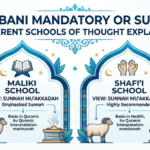
Classical scholars from all four Sunni schools agree on the permissibility of the three-part division while emphasizing flexibility based on need.
- Hanafi scholars allow giving most or all of the meat in charity
- Shafi’i scholars emphasize the balance between consumption and charity
- Maliki and Hanbali scholars also support distribution with priority to the needy
Contemporary Context
Modern scholars highlight:
- The importance of global distribution through charities
- Supporting impoverished regions worldwide
- Adapting distribution methods to urban lifestyles
This shows that while the principles remain constant, application can adapt to context.
Applying Qurbani Meat Distribution in Western Countries
For Muslims in the USA and UK, practical challenges may arise:
Common Situations
- Limited access to local slaughterhouses
- Difficulty identifying needy individuals
- Storage and distribution logistics
Practical Solutions
- Partner with trusted Islamic charities
- Distribute within local mosques or community centers
- Share with neighbors to build community bridges
These approaches ensure that the essence of Qurbani is preserved, even in non-Muslim-majority societies.
In modern contexts, many Muslims choose digital solutions, which raises important questions addressed in Can You Give Qurbani Online? Best Practices and Islamic Rulings. This resource explains how to fulfill your obligation responsibly through trusted online platforms.
Conclusion
Qurbani is more than a ritual sacrifice. It is a powerful expression of faith, obedience, and compassion. Proper Qurbani meat distribution ensures that this act benefits not only the individual but the entire community.
By following the recommended three-part division, prioritizing the needy, and adhering to Islamic guidelines, Muslims can fulfill this obligation in a meaningful and impactful way. Whether you are distributing locally or globally, the key is sincerity, fairness, and generosity.
As you continue to deepen your understanding of Islamic practices, institutions like Najam Academy provide structured Quranic learning for Muslims in the USA and UK. With affordable packages and global accessibility, it serves as a valuable resource for those seeking authentic Islamic knowledge.
Disclaimer:
This article is for educational purposes only and does not constitute a fatwa. Please consult qualified scholars for personal rulings.
References
Quranic Verses:
- Quran 22:37
- Quran 60:8
Hadith References:
- Sahih al-Bukhari 1716
- Sahih al-Bukhari 5569
- Sahih Muslim 1971
About the Author:
With over 18 years of experience in Islamic education and teaching, I have dedicated my work to helping students and readers develop a deeper understanding of Islam through authentic knowledge and practical guidance. My studies include Quran, Hadith, Aqeedah, Seerah, and Islamic history under qualified scholars, with a strong focus on presenting classical Islamic teachings in a clear, balanced, and accessible way for modern audiences. Through years of teaching, curriculum development, and educational mentoring, I aim to make Islamic learning engaging, reliable, and spiritually enriching for students of all ages.
Syed Fawwad Ahmed